
A wingfoil downwinder is one of the most rewarding ways to experience wingfoiling. Instead of riding backwards and forwards from the same beach, you launch at one location and use the wind and swell to travel downwind towards another.
At first, a downwinder can simply mean using the wing to ride from point A to point B. But as your skills improve, the experience changes completely. You start using the energy of the water, catching wind swell, flagging the wing, gliding down bumps and trying to connect one section of swell to the next.
Eventually, the wing becomes less of an engine and more of a tool that helps you get onto foil, recover speed and continue when the swell is not doing the work for you. This guide explains how to prepare for your first wingfoil downwinder, how to ride downwind efficiently, how to start using swell and how to do it safely.
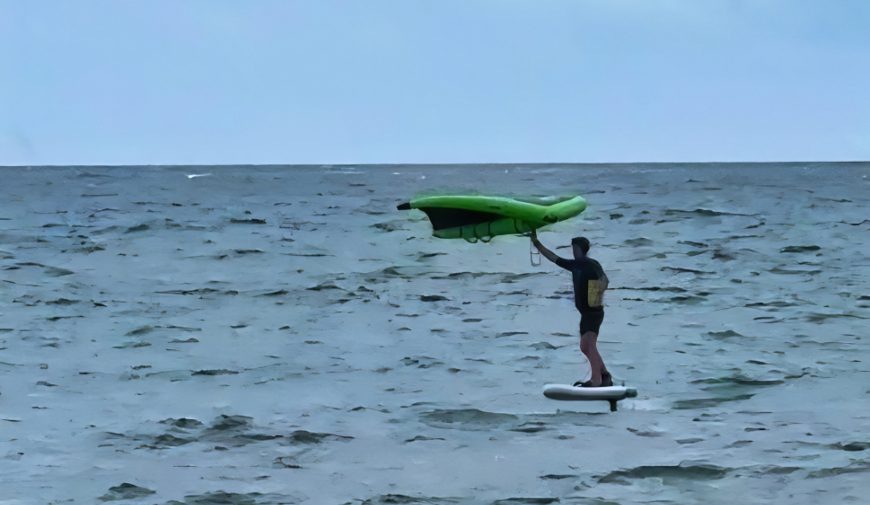
Wingfoiling down wind
How to ride a wingfoil downwinder
What is a wingfoil downwinder?
A downwinder is a one-way wingfoil session. You start at an upwind location and finish somewhere further downwind.
During a normal session, you can usually return to the same beach whenever you want. During a downwinder, you are gradually moving away from your starting point, so route planning, safety and logistics become part of the session.
Your first downwinder may involve keeping both hands on the wing for almost the entire trip. More experienced riders use the wing less and begin surfing wind swell with the wing flagged.
You also do not need to travel directly downwind. Efficient downwind riding usually involves broad angles and gentle turns as you search for the best bumps and maintain speed.
Are you ready for your first downwinder?
You do not need to be an expert wave rider, but a downwinder should not be your first experience of riding away from the beach.
Before attempting one, you should be comfortable getting onto foil, controlling your direction and restarting in choppy water.
Ideally, you should already be able to:
- Get onto foil reliably.
- Ride comfortably in both directions.
- Ride upwind and downwind under control.
- Change direction confidently.
- Restart in chop and swell.
- Control your equipment after a fall.
- Get yourself back to shore if you cannot continue foiling.
Your first downwinder can be ridden almost entirely using normal wing power. Surfing bumps and flagging the wing can come later.
Practise riding downwind first
Before organising a point-to-point trip, practise deep downwind riding during your normal wingfoil sessions. Start from a normal crosswind course and gradually bear away from the wind. As you turn further downwind, the pressure in the wing reduces.
This happens because you are travelling more in the same direction as the wind, reducing the apparent wind you feel. Do not immediately point straight downwind. Ride broad angles and become comfortable with having less power in the wing.
Your body position will also change. When riding powered across or upwind, you often lean against the wing. Riding deep downwind requires a more neutral stance, with more of your attention going towards controlling the foil through your feet.
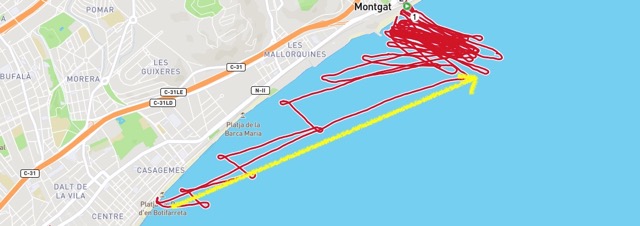
and then do a down wind stretch (see yellow arrow) to practice.
Wingfoil downwind board
A wingfoil downwind board is typically longer and narrower than a conventional wingfoil board. The idea is to reduce drag and make the board accelerate more efficiently through the water before the foil lifts. That means you can get onto foil with less wing power and keep moving more efficiently in marginal conditions.
For wing-assisted downwinders, you don’t necessarily need a dedicated downwind board. A normal wingfoil board works perfectly well, particularly for your first downwinders. But a longer, narrower board becomes interesting as you progress towards riding smaller wings and relying more on the swell. Dedicated downwind-style boards have a longer waterline and less width than conventional wingfoil boards. This helps them glide and accelerate efficiently before takeoff. With less resistance through the water, you can often get onto foil using less wing power.
Choose an easy first route
Your first wingfoil downwinder should be simple and relatively short. Choose a route that follows a safe coastline and gives you multiple places to come ashore if necessary. Avoid routes with cliffs, rocks, harbour entrances, shipping lanes or long stretches where exiting the water would be difficult.
Wind direction is crucial. The wind should naturally help carry you towards your destination rather than push you offshore. Do not make distance the goal. A short, successful downwinder is far more useful than a long session where you spend most of your time struggling.
Plan the finish before you launch
A downwinder finishes somewhere different from where it starts, so transport needs to be planned in advance.
You can use two cars, arrange a collection, organise a shuttle or taxi, or choose a route with convenient public transport.
Decide exactly where you intend to finish before you launch.
Arriving several kilometres down the coast with a board, foil and wing is not the ideal moment to start working out how to get back.
Check the whole route
Do not only check the forecast at your starting beach.
Look at the wind along the entire route. Headlands, buildings or changes in coastline can create wind shadows or significantly change the wind direction.
You should also consider:
- Tides and currents.
- Swell direction.
- Rocks and reefs.
- Boat traffic.
- Harbour entrances.
- Possible exit points.
- Changes in weather during the session.
Clean wind swell travelling roughly in the direction of your route is much easier to use than confused water with waves approaching from several directions.
Use the wing on your first downwinder
There is no reason to immediately copy advanced riders who spend long sections with their wing completely flagged.
For your first downwinder, use the wing as much as you need.
Ride broad reaches towards your destination and use normal wing power to stay comfortably on foil.
This allows you to concentrate on the route, understand the conditions and get used to travelling away from your starting point.
Once you feel relaxed doing that, you can gradually start using less wing power.
Start reading the water
The biggest step in downwind progression happens when your attention moves away from the wing and towards the water.
Wind creates small lines of swell and moving bumps. These bumps contain energy that your foil can use.
Look ahead and try to identify a useful section of swell moving in roughly the direction you want to travel.
As you move onto the back of a bump and accelerate down its face, you should feel the foil speed up.
That acceleration allows you to reduce the power from the wing.
Do not ride straight downwind
A downwinder does not mean pointing directly downwind and staying there.
The bumps are constantly changing shape and direction. You may ride diagonally across one bump, then change direction to connect with another.
Your route will often look like a series of smooth turns rather than one straight line.
This is usually more efficient because it helps you maintain speed and stay connected to the energy in the water.
Learn to flag the wing
Once you are comfortably using swell, you can begin experimenting with flagging the wing.
Flagging means holding the wing by the leading-edge handle so that it flies neutrally rather than producing significant forward power. Before flagging, make sure you already have enough speed and that the swell is helping the foil glide. Then release your back hand and let the wing drift while you focus on riding the foil. At first, only do this for a few seconds. If you begin losing speed, grab the wing again, create power and continue. That is one of the great advantages of using a wing for downwind riding: your power source is always available when you need it.
You do not need to be on a real downwinder to practise flagging. During a normal session, get onto foil, bear away slightly and flag the wing for a few seconds. Try to stay flying using the energy of small wind-generated bumps. If you slow down, use a few foil pumps or simply power up the wing again. Learning this near your normal launch is much easier than experimenting for the first time when you are already several kilometres into a downwinder.
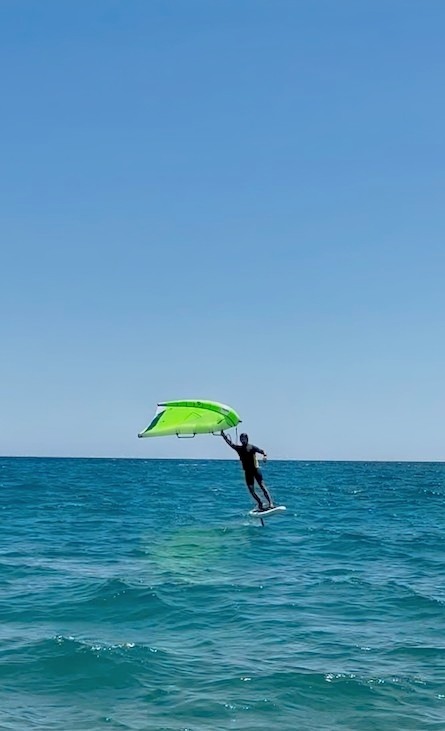
Flagging the wing
Flagging the wing means you keep the wing flat (horizontal), allowing the wind to go under it without powering it. You can ride waves to get speed, and drag the wing behind you if you are faster than the wind. If you are not riding faster than the wind, you can allow for the wing to be flagged in the direction of the wind, as you see on this picture.
How to catch a wave
Downwind bumps are often much smaller than breaking surf waves. What matters is not their size but the energy moving through the water.
- Approach with speed and look for the steeper part of the bump.
- As the foil begins to accelerate, gradually reduce wing power.
- Try to stay on the sloping face rather than riding directly through the bump into flatter water.
- A slightly diagonal line can help you stay connected to the energy for longer.
- Keep your knees flexible and control the height of the foil. As your speed increases, you may need more front-foot pressure to stop the foil climbing too high.
Connecting waves
The next major skill is learning to connect one wave to another. Do not wait until the first bump has completely disappeared. While you still have speed, look ahead and to the side for the next promising section of water. Use the momentum from your current bump to turn towards the next one. If necessary, add a few efficient foil pumps to cross the flatter water between them.
If the connection does not work, use the wing to regain speed and try again.
Use foil pumping efficiently
Foil pumping is extremely useful during a downwinder, but it should support the energy in the water rather than replace it. A few smooth pumps can help you connect two bumps. If you find yourself pumping hard for a long period, it is usually more efficient to use the wing again. Save your energy and wait for the next opportunity to glide.
Keep looking ahead
Good downwind riders spend a lot of time scanning the water in front of them. The bump you are currently riding matters, but the next one is often more important. Look for steeper sections, more defined lines and pieces of swell moving in a useful direction.
With practice, the surface of the water starts to look less random. You begin recognising where energy is building and where it is disappearing.
What to do when you fall
Falling is part of downwind riding. First, make sure you and your equipment are under control. Look around and check your position before immediately trying to restart. Then use your normal water-start technique to get back onto foil. This is one of the reasons why reliable starts in choppy water are important before attempting longer downwinders. If restarting becomes difficult, do not allow yourself to drift into a dangerous position while repeatedly trying. Use your equipment and available exit points to make the safest choice.
Common wingfoil downwinder mistakes
- Trying to go directly downwind
Use broad angles and follow the swell rather than forcing the shortest possible route. - Flagging the wing too early
Build speed first. If you flag before the foil has enough momentum, you will simply slow down and touch down. - Looking at the wing instead of the water
Once the wing is neutral, your attention should be mainly on the water ahead. - Waiting too long before connecting the next bump
Use the speed from your current bump while you still have it. Do not wait until all the energy has disappeared. - Pumping too much
A downwinder should gradually become more efficient. Pump to connect energy, but use your wing again when necessary. - Choosing a route that is too ambitious
Start short. Build distance only after you are comfortable with the technique, conditions and logistics.
Safety tips for a wingfoil downwinder
A downwinder can take you much further from your starting point and sometimes further offshore than a normal session. Good preparation is therefore essential.
- Bring water (and food)?
Downwinders can take longer than expected. Bring drinking water, particularly on warm days. A hydration pack, Camel bag, or a regular bagpack can be a practical solution because it allows you to carry water comfortably while riding. Consider taking a banana with you. - Carry your phone in a watertight bag
Bring a fully charged phone in a waterproof or watertight bag. Keep it attached to you rather than to your board so you still have access to it if you become separated from your equipment. - Save the local rescue service number
Before launching, find the telephone number of the relevant local coastguard, maritime rescue service or emergency service and save it in your phone. Do this before the session rather than trying to find the number when something has already gone wrong. - Tell people where you are going
Make sure somebody on land knows your plan. Tell them where you are launching, your intended route, where you expect to finish and approximately what time you plan to arrive. For longer routes, agree on what they should do if they have not heard from you by a certain time. - Go with somebody else
Whenever possible, do your downwinder with another rider. Stay aware of each other’s position during the route rather than simply agreeing to meet at the finish. If somebody has equipment problems, becomes injured or cannot restart, having another rider nearby can make a major difference. - Consider using a support boat
For longer, remote or more challenging routes, a support boat can add a significant extra layer of safety. A boat can follow the group, assist if somebody has equipment problems and collect a rider who cannot continue. This is especially valuable if your route takes you far offshore or along coastline with few safe exit points. - Use sunscreen
A downwinder can mean several hours of exposure to the sun. Use water-resistant sunscreen and consider additional UV protection suitable for the conditions. - Consider using a professional service
If you want to experience a proper downwinder but are uncertain about the route, currents, wind, swell or logistics, consider joining an organised session with experienced local professionals. Services such as Downwinders.es organise downwind experiences and can help with route planning, local knowledge and logistics. This can be particularly useful for your first serious downwinder because it allows you to concentrate more on riding, reading the swell and improving your technique. - Have a plan for problems
Before launching, ask yourself what happens if the wind drops, your wing gets damaged, you cannot continue foiling or you need to finish earlier than planned. Know where your alternative exit points are and whether you can safely reach land from every part of the route. If you do not have good answers to those questions, reconsider the route.
See more wingfoil safety tips.
Your first wingfoil downwinder
Keep your first attempt simple. Choose a short route along a safe coastline, go with another rider if possible and choose steady conditions that you already feel comfortable wingfoiling in. Do not make swell riding the main objective.
Your first goal is simply to launch at one location, travel downwind under control and arrive safely at your planned finish. Use the wing as much as you need. During the session, experiment with flagging it for a few seconds when you find a useful bump. Then power up again. On future sessions you may stay on one bump longer, connect two together and gradually spend more time riding with the wing neutral.
Progress gradually
There is a big difference between riding downwind close to your local beach and committing to a long open-water downwinder.
Build your skills step by step. Practise deep downwind riding, flagging the wing, pumping the foil and using small wind swell during normal sessions first. Then begin with short routes with easy exit options. As your ability to read the water, connect bumps and restart in difficult conditions improves, you can gradually consider longer and more adventurous routes.
The goal is not simply to cover as much distance as possible. A great wingfoil downwinder is one where you stay in control, use the wind and swell efficiently and arrive safely at the other end already thinking about the next one.


