
That unbelievable feeling of flying above the water is one of the many things that makes wingfoil such a great experience. As soon as you are done learning how to take-off and start flying, it’s about learning how to keep yourself on the foil. That’s why there is this wingfoil tutorial! How to maintain flight is very important. Once you have it mastered, your wingfoil life is going to the lext level. In this article, we will go into the tips and tricks that will help you keep a steady flight, relax, enjoy and do it in a way that allows you to enjoy long sessions without getting tired.
Winfoil tutorial – How to maintain flight and keep going
In wingfoil, as soon as you take off, the dynamic of the board and the interaction with the water and your body changes. During taxi and take-off you experience drag from the water. But as soon as you are flying (also called: “you are on the foil”), the whole dynamic changes. Your board will speed up because of the lack of drag and your board wants to keep climbing. Also, especially in the beginning, the altitude and speed may impress you so much that you tense up.
Therefore, you need to do a couple of things in order to maintain a steady flight and keep going.

What changes when you fly in wingfoil?
As soon as you are on the foil, your board and wing need to be adjusted to the flight. Think about how an airplane that takes off from the ground, needs to change it’s configuration from take-off mode to flight mode.
Airplanes modify their configuration as soon as they are off the ground: they retract their landing gear, they retract their flaps and trim the nose down so they fly horizontally. There is a different technique needed for taking off than there is for flying.
In wingfoil, the principles are more or less comparable. This wingfoil tutorial helps you. How to maintain flight is a piece of knowledge that will bring you to the next step of foiling.
In wingfoil, you start by taxiing on the water until you find a right moment to take off. For take-off, you need power and speed, as you need to free the board from the resistance and the drag that the water has on it. As soon as that happens, the board gets out of the water and you are “on the foil”. Now your priority is to go into “flight mode” and no longer in “take-off mode”. In short: you start working on how to fly and how to maintain flight over a longer distance and time.
Your priority when flying in wingfoil is to have your board in a position where it’s horizontal as opposed to climbing.
Wingoil tutorial: how How to keep flying

As soon as you take off, push the nose down so the board stops climbing.
Once you have taken off, you are “on the foil” and you need to stop the board from going up further. This way you make sure the foil does not break the water line. If the foil breaches the water line, you will fall.
You can go from take-off mode to flight mode by a couple of actions. Not all of them are always needed, but you can combine them if necessary.
What you want is a horizontal board position instead of a climbing board.
- Press down on your front foot
- Shift your weight to the front
- Move your back foot a bit forward
How to maintain flight in wing foil: body position is very important
In your first sessions, you may be so thrilled by this new experience of flying on the water, that your body may be very tense. You may squeeze your hands and tense your legs and arms without noticing. After 20 minutes, you are totally wrecked by all this energy that your body consumes.
Therefore, it’s important to relax while you ride. Here a a couple of tips to keep in mind about the position of your body.
- Keep your back straight, so you stand up. This allows you to relax and it’s a great work-out for your back.
- Flex your knees a little bit, so you can use them to adjust the altitude of your flight. If you notice you go up too much, press down with your front foot. If you notice you are too low, shift your weight backwards.
- Try to stretch your arms, so you don’t forcedly tense your muscles. You can adjust the wing position by using your arms and / or using your shoulders. If you get tired in your arms, use your shoulders (with arms straight) and the other way around.
- Grab the wing handles with your fingers instead of your closed fist. It helps your relax your hands and it allows you to keep your grip longer, which means a longer session.
- If you are in choppy water, it may help to put your body in a position that looks like a 4.
- If you are in flat water, you can stretch your body more, and relax.

Stretch your body and arms.
This saves you energy and allows for a longer session. Keep your body straight and try to relax your arms. Don’t flex your biceps and triceps all the time, let the wind carry you. Make small adjustments where needed.
Look forward, not down.
Especially in the beginning, people tend to look down to the water. This forces your body in a bad position. Like riding a bike, look towards where you want to go. It helps you asume a healthy and balanced position for wingfoil flying.
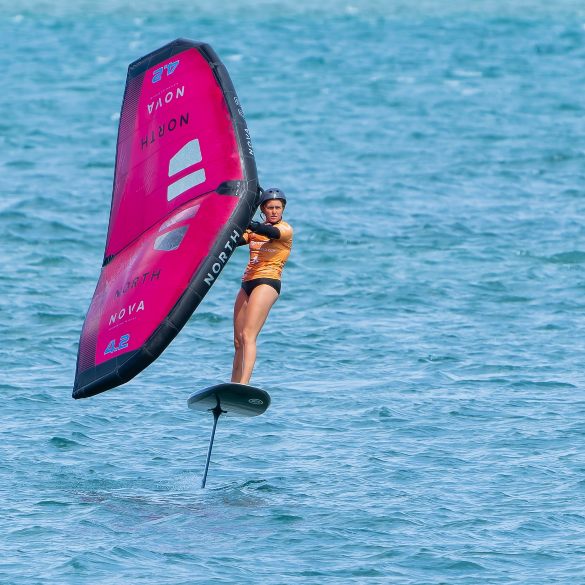

In choppy water, keeping a 4-like position may enable you to anticipate on the waves better.
Keep your back straight, flex your knees and use your legs to adjust your position. You can use your legs to anticipate on the waves if needed.
However, remember that you are flying over the water so more often than not the waves will just pass underneath you! If you come from windsurf, this is a totally new experience as you are used to feel every wave.
Relaxing is very important to fly further and better.
Doesn’t it look like good winfgoilers all stand on their boards so relaxed? It seems like it does not take them any effort at all!
Relaxing is key. You will notice you are more comfortable if you are relaxed.
You can help yourself by focusing on your breath and trying to breath in and out a bit deeper. It will bring your heart rate down, making you feel more zen, enjoying the water sport more. Also it saves a lot of energy so your session will be longer.


